
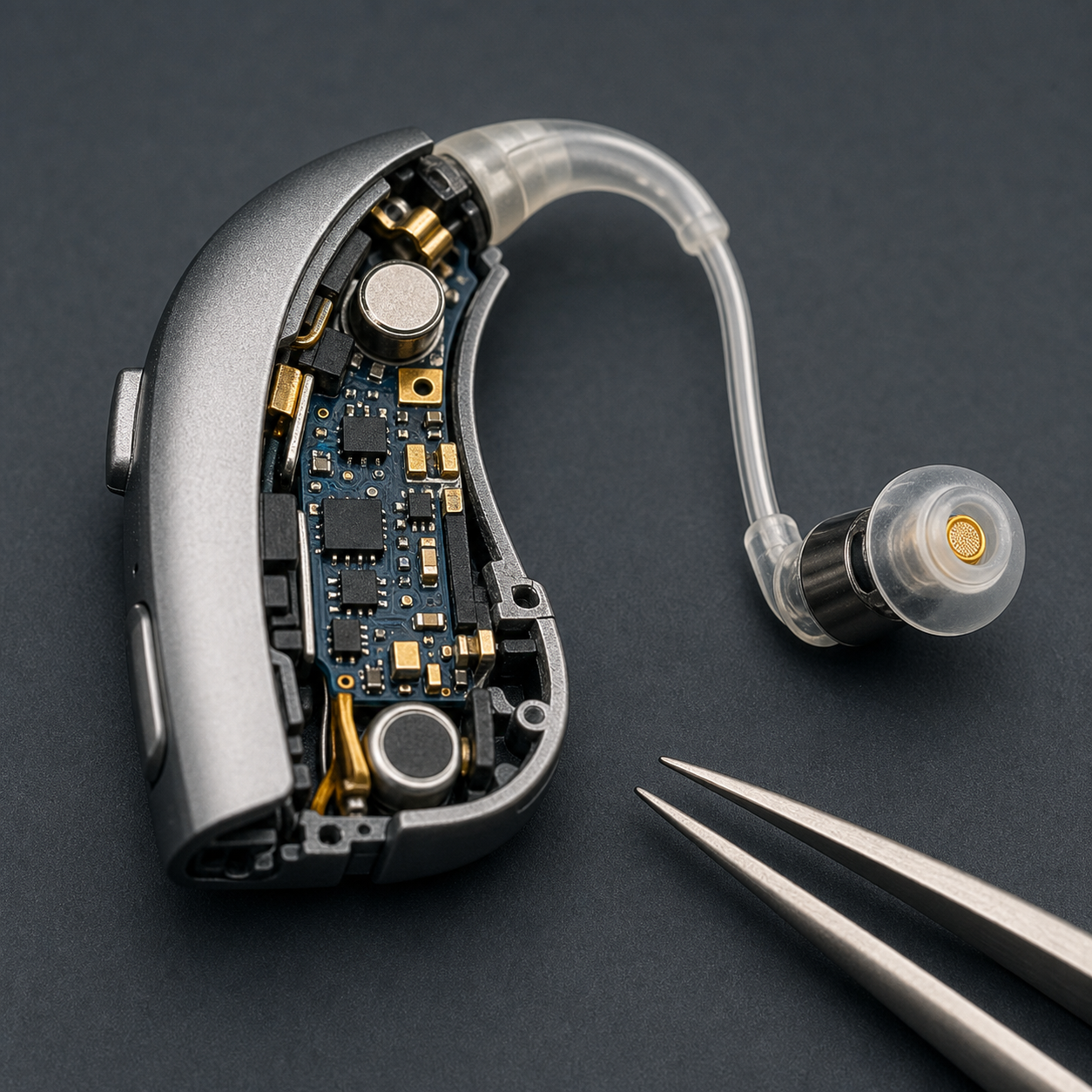
There is no single winner between in-ear and behind-the-ear hearing aids. In-ear styles may prioritise discretion, while RIC and BTE can offer broader power, microphone, battery and connectivity options. Current hearing assessment, anatomy, dexterity and listening environments should guide the choice.
In-ear and behind-the-ear comparison
| Criterion | In-ear IIC/CIC/ITC/ITE | Behind-the-ear RIC/BTE |
|---|---|---|
| Visibility | IIC and CIC can be least visible | Modern RIC can also be discreet |
| Power range | Depends on shell and receiver space | Generally broader, especially BTE |
| Rechargeable options | Available in selected larger models | Widely available |
| Wax exposure | All electronics sit near the canal | RIC receiver is in canal; BTE body remains outside |
| Handling | Tiny models can be difficult to handle | Larger controls may be easier |
| Connectivity | May be limited in smallest shells | Often broader phone and accessory support |
Quick comparison
Low visibility: IIC or CIC
Broad power range: BTE or suitable power RIC
Charging and phone connectivity: RIC, BTE or larger ITE
Difficulty handling small devices: BTE, RIC or larger ITE
Avoiding contact with glasses: in-ear
Children: generally BTE with replaceable earmould
Accessible parts and routine care: model-dependent BTE or RIC
Styles in each group
In-ear styles include IIC, CIC, ITC and ITE, increasing in size and potential component space. Behind-the-ear styles include classic BTE, mini BTE and RIC/RITE, where the receiver sits in the canal.
Visibility
IIC and CIC are often least visible, but anatomy and required power determine shell size. Modern RIC devices can also be discreet. Handling, microphone capacity and care should not be sacrificed for appearance alone.
Hearing loss and power
BTE devices can cover a broad power range. RIC devices offer different receiver powers and fitting options. Larger ITE models may suit some greater losses, while tiny IIC/CIC shells may have output and battery limits.
What determines sound quality?
Style alone does not determine performance. Technology, microphones, receiver, dome or earmould, physical fit, programming and speech discrimination all matter.
Speech in noise
Directional microphones, binaural communication, noise management and appropriate coupling can help. Tiny IIC devices may have less room for multiple microphones, while larger ITC/ITE, RIC and BTE can offer more hardware space.
Charging, batteries and phones
RIC and BTE generally offer a wider range of rechargeable and wireless options. In-ear rechargeable devices reduce battery handling but component space affects shell size. Verify all phone features with the exact model and your own phone.
Glasses and daily handling
In-ear devices do not contact glasses. Small RIC devices may also work comfortably with proper placement. For limited dexterity or vision, rechargeable BTE, RIC or larger ITE may be easier than IIC/CIC.
Children
BTE is commonly considered because the earmould can be replaced as the child grows, and power, safety, remote microphone and caregiver handling options are broad. Paediatric selection requires specialist follow-up.
Wax, moisture and care
All in-ear electronics are close to wax and moisture. BTE bodies remain outside the canal but are exposed to perspiration; RIC receivers remain in the canal. Every style needs model-appropriate dry care.
Maintenance and repair
BTE tubing and earmoulds, and some RIC receivers, may be modular. In-ear components sit within a small custom shell. Repairability still depends on exact model, fault, age and parts availability.
Price and Turkish SGK
No style is always cheaper. Compare the exact product and written service package. SGK eligibility requires compliant documentation and a contracted centre; confirm current MEDULA entitlement and user difference on the transaction date.
Use a current hearing assessment
Audiometry guides power, receiver, coupling, earmould and programming. Selection is completed through individual fitting, real-life experience and follow-up adjustments.
Selection and service in Izmir
Consider humidity, programming access, consumables and technical service. Physical technical-service intake is available only at Bozyaka and Yesilyurt in Karabaglar. Nokta Hearing is an independent multi-brand service.
Before requesting service
- Current audiometry and speech results reviewed
- Anatomy and required power assessed
- IIC, CIC, ITE, RIC and BTE tried
- Independent handling confirmed
- Phone, charging or battery needs tested
- Total cost, follow-up and service received in writing
Nokta Hearing Technical Service
This article is limited to technical device care, use and service preparation. It is not medical diagnosis or treatment advice.
Published and updated: 23 July 2026Questions about this topic
Is in-ear or behind-the-ear better?
There is no single answer. In-ear may improve discretion, while RIC/BTE may offer power, connectivity and handling advantages.
Which is more powerful?
BTE generally offers the broadest power range.
Which may be better in noise?
Larger ITC/ITE, RIC or BTE models may have more room for directional microphone systems.
Which is suitable for children?
BTE is commonly considered because the earmould can be replaced as the ear grows.
Which is easier to repair?
BTE/RIC may have modular components, but repairability depends on model, fault and parts.
Can SGK apply to both styles?
The current process may apply when documentation and contracted-centre requirements are met.