
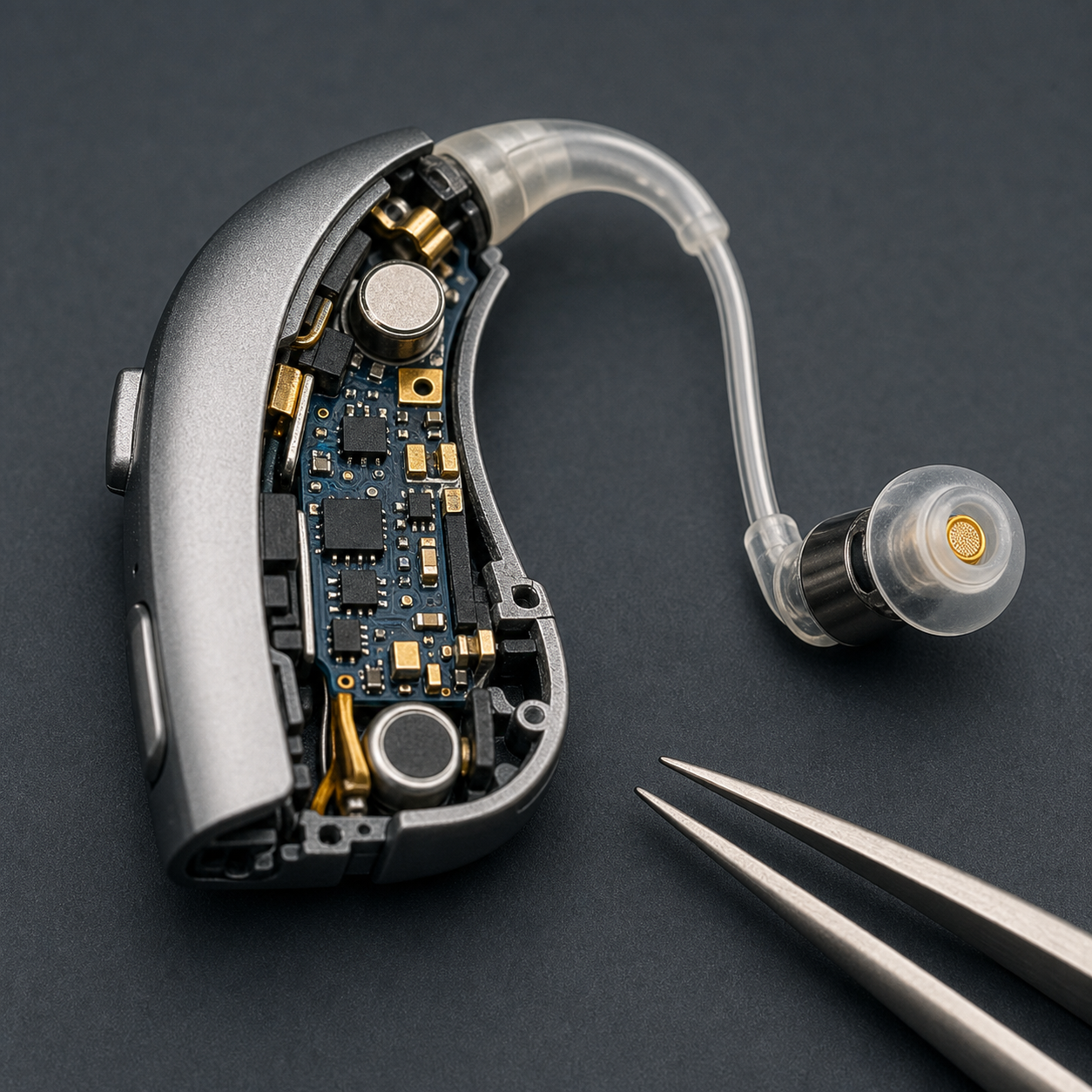
The cost of one hearing aid cannot be determined by brand or shell style alone. Hearing profile, technology, charging, connectivity, fitting components and follow-up services all affect the total. A standard device, a single device chosen despite bilateral loss, and a two-unit CROS system are different solutions. Confirm the exact retail quote and any current Turkish SGK entitlement in writing on the transaction date.
Approximate 2026 price bands for one device
Indicative market bands only. Brand, model, exchange rate, campaign and service scope can change the quote.
| Technology or device group | Approximate price for one device |
|---|---|
| Entry-level digital device | TRY 15,000–30,000 |
| Mid-range digital device | TRY 30,000–50,000 |
| Advanced technology device | TRY 50,000–70,000 |
| Premium device | TRY 70,000–90,000 and above |
| Custom in-ear device | TRY 20,000–70,000 and above |
| Rechargeable Bluetooth RIC/BTE | TRY 25,000–90,000 and above |
| High-power BTE | Approximately TRY 30,000–90,000 and above, depending on technology |
| CROS or BiCROS system | Priced separately because it commonly uses two units |
Common hearing-aid battery sizes
| Battery | Colour code | Typical use |
|---|---|---|
| 10 | Yellow | Small canal devices |
| 312 | Brown | RIC, mini BTE and canal devices |
| 13 | Orange | BTE and higher-power devices |
| 675 | Blue | High-power BTE devices |
What does “one hearing aid” mean?
It may describe aidable loss in one ear, buying only one device despite bilateral loss, replacing one device, or researching CROS for unaidable unilateral loss. Each situation requires a different assessment and cost comparison.
How to obtain a reliable 2026 price
There is no single tariff covering every brand and service package. Exchange rates, product generation, technology, receiver, custom mould, charger, accessories and aftercare affect the quote. Ask for the exact product code and a current written breakdown.
What should the quote include?
Exact brand, model and technology tier
Individual programming and user training
Follow-up and fine-tuning scope
Dome, mould, receiver or tubing
Charger, case or starter batteries
Filters and care supplies
Warranty, maintenance and technical-service terms
Who may be suitable for one device?
A single device may be considered when one ear has aidable loss and the other has normal or usable hearing. If both ears have aidable loss, two devices may be evaluated for balance, speech access and localisation. Audiometry, speech testing and medical context guide the decision.
Unilateral loss, CROS and BiCROS
If one ear is unlikely to benefit from conventional amplification, CROS or another clinical option may be assessed. CROS commonly has a transmitter on the poorer side and a compatible receiving aid on the better side, so it should not be priced as an ordinary single device. BiCROS also amplifies loss in the better ear.
Sudden loss in one ear
A decrease developing over hours or days needs prompt ENT assessment, with or without tinnitus, fullness or dizziness. Do not delay medical evaluation while shopping for a device.
Main cost factors
Technology tier and product generation
BTE, RIC, ITE, ITC, CIC or IIC style
Disposable battery or rechargeable system
Bluetooth, app and TV connectivity
Receiver power and custom earmould
Individual fitting and follow-up
Warranty, care and parts availability
BTE, RIC and in-ear comparison
BTE can offer broad power and control options. RIC combines a small body with selectable receiver powers but needs receiver and filter care. In-ear devices may be custom-made; very small shells can limit battery, power and wireless hardware. Compare the exact model, not only the style name.
One device or two?
One device has a lower initial total, but price alone should not override bilateral clinical needs. Compare devices, chargers, moulds, SGK processing and follow-up as one written package.
Turkish SGK contribution
Where current report, prescription, audiometry and MEDULA requirements are met, SGK may contribute a defined amount through a contracted hearing-aid centre. It need not cover the full retail price. Verify entitlement, renewal rules, contribution and user difference on the transaction date.
Why audiometry matters
Right and left thresholds help guide power, receiver, coupling and programming. Speech discrimination helps estimate potential benefit in each ear. The fitting side is not chosen solely by which ear seems poorer.
Battery, charging and repair
Battery use varies with power, streaming and environment. For rechargeable models, confirm charger inclusion and battery-service terms. A failed device does not automatically need replacement: filters, receivers, microphones, contacts, moisture and electronics can be inspected first.
Selection and service in Izmir
Compare the complete written package and consider humidity care, consumables and service access. Nokta Hearing accepts physical technical-service intake at Bozyaka and Yesilyurt in Karabaglar. Devices from outside Izmir are accepted only by shipment to the Izmir service centre.
Before requesting service
- Current medical and hearing assessment available
- Single, bilateral and CROS options understood
- Exact model and product code received in writing
- Charger, mould, receiver and accessories checked
- Fitting, follow-up, warranty and service clarified
- Current SGK entitlement and user difference verified
Nokta Hearing Technical Service
This article is limited to technical device care, use and service preparation. It is not medical diagnosis or treatment advice.
Published and updated: 23 July 2026Questions about this topic
How much is one hearing aid?
There is no universal price. Request a current written quote for the exact model, components and service package.
Are online prices for one device?
Not always. Confirm whether the amount covers one aid, two aids or a CROS system and what services are included.
Is one aid enough for bilateral loss?
If both ears are aidable, two devices may be considered. The decision depends on hearing and speech results and daily needs.
Is CROS a single device?
Usually not. A CROS system commonly contains a transmitter and a compatible receiving hearing aid.
Does SGK make one hearing aid free?
Not necessarily. SGK contribution may not equal the full retail price; verify the current user difference.
Which ear receives the device?
The choice uses audiometry, speech discrimination and medical context, not only which ear sounds poorer.
Can one hearing aid be repaired?
Many faults can be assessed; repairability depends on the fault, device age and parts availability.