
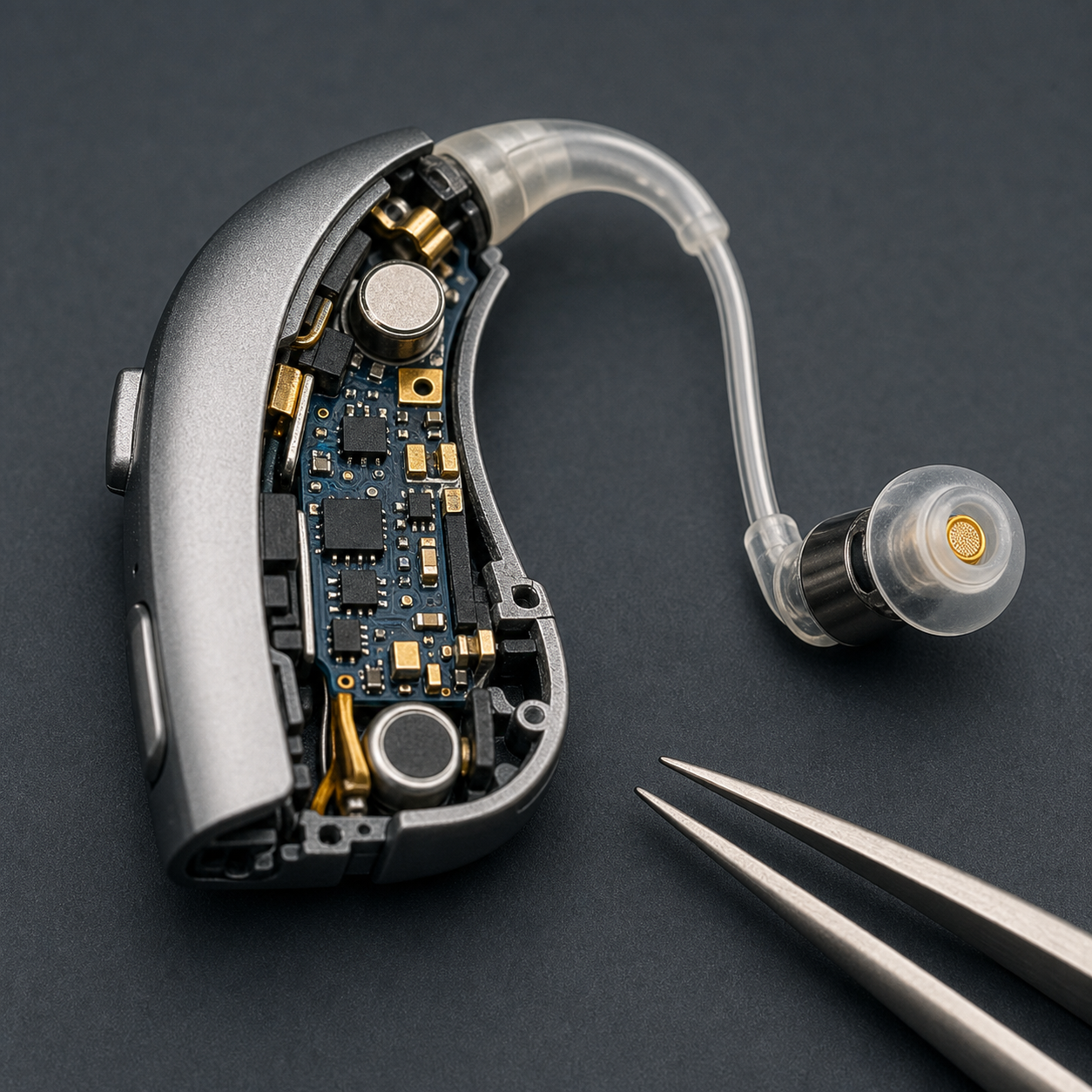
No single brand and model is the best in-ear hearing aid for everyone. The appropriate device depends on current hearing assessment, ear-canal anatomy, speech needs, handling and individual programming. The smallest, newest or most expensive device does not guarantee the best result.
In-ear hearing aid styles at a glance
| Style | Position and practical profile |
|---|---|
| IIC | Deepest placement and lowest visibility; limited component space |
| CIC | Completely in the canal; small battery and controls |
| ITC | Canal entrance; more room for controls and wireless functions |
| ITE | Fills more of the outer ear; broader power and handling options |
Criteria for the best in-ear device
Appropriate power and fitting range
Comfortable and secure physical fit
Speech processing suited to daily needs
Ability to insert, remove and clean the device
Adequate battery or daily charging time
Verified compatibility with the user’s phone
Access to consumables, programming and service
IIC, CIC, ITC and ITE explained
IIC sits deeper and can be very discreet, with possible space, battery and power limitations.
CIC sits completely in the canal and may balance discretion with component space.
ITC sits near the canal entrance and can be easier to handle with room for controls.
ITE occupies more of the outer ear and may offer easier handling, power, charging and connectivity.
Instant-fit canal devices use replaceable soft tips rather than a custom hard shell.
Is the least visible device always best?
Actual visibility depends on anatomy, power and component space. Very small devices can have less room for batteries, controls, wireless features, microphones and output. ITC or ITE may be more practical for limited dexterity or vision.
Who may be suitable?
In-ear devices may suit users seeking low visibility, no device behind the ear and a custom shell. Canal size, wax, moisture, skin sensitivity, power and daily handling must also be assessed.
When a tiny canal device may be impractical
Difficulty handling small devices or batteries
A narrow or unsuitable ear canal
Frequent wax blockage or heavy moisture
Very high output requirements
Childhood growth requiring shell changes
Ear pain, discharge or an active medical concern
Use a current hearing assessment
Audiometry affects power, receiver, shell style, venting, one- or two-device assessment and programming. Choosing only by appearance can produce insufficient output, discomfort or feedback.
How a custom shell is made
After the canal is checked, an ear impression or supported digital process captures anatomy. Shell depth, venting and component placement affect comfort and feedback. Fit, insertion and sound should be checked at delivery.
In-ear versus RIC or BTE
In-ear devices can be discreet and avoid contact with glasses. RIC and BTE may offer broader power, microphone, battery, connectivity and maintenance options. No style is superior for every user.
Rechargeable or replaceable battery
Rechargeable devices reduce small-battery handling but require charging and future battery planning. Battery models often use size 10 or 312, with some larger ITE models using 13. Use only the specified battery.
Phone compatibility
Bluetooth functions vary by exact device, phone and operating system. Test pairing, calls and media with your own phone. The smallest IIC and CIC options may offer fewer wireless features.
How to compare prices
Cost varies by exact model, tier, custom manufacture, charging, connectivity, power, accessories, programming and follow-up. Confirm whether the quote is for one or two devices and obtain the complete service package in writing.
Turkish SGK process
SGK states that compliant prescribed hearing devices are supplied through contracted centres. Coverage may not equal the full retail price. Reports, prescription, current amount and MEDULA eligibility must be checked on the transaction date.
Care and technical service
In-ear devices are exposed to wax and moisture. Use dry model-appropriate care and never open the shell. Repairability depends on the exact model, fault, shell condition and parts availability. Nokta Hearing is an independent multi-brand technical service.
Selection and service in Izmir
Consider audiometry, canal suitability, phone compatibility, warranty, follow-up and consumables. Physical technical-service intake is available only at Bozyaka and Yesilyurt in Karabaglar.
Before requesting service
- Current hearing assessment completed
- Canal and handling ability assessed
- IIC, CIC, ITC, ITE and RIC compared
- Compatibility tested with own phone
- Total cost and services received in writing
- Care, consumables and service access confirmed
Nokta Hearing Technical Service
This article is limited to technical device care, use and service preparation. It is not medical diagnosis or treatment advice.
Published and updated: 23 July 2026Questions about this topic
What is the best in-ear hearing aid?
It depends on hearing assessment, anatomy, speech needs and handling. There is no single best model.
Which style is least visible?
IIC is among the most discreet, but visibility depends on anatomy, power and shell size.
Can in-ear devices support severe loss?
Some larger ITE options may be suitable, while tiny IIC/CIC devices may not provide the required output.
Is in-ear better than RIC?
Each has different advantages. The appropriate style depends on individual needs.
Can an in-ear hearing aid be repaired?
Many can be assessed, but repairability depends on the fault, shell and parts availability.
Does SGK make an in-ear device free?
Not necessarily. Coverage may not equal the full retail price and the current user difference must be confirmed.